


Recently, Chambers and Partners, the internationally recognized legal ranking authority, officially released the full version of its 2026 Global Tax Disputes Practical Guide. M&T Lawyers was invited to author the China chapter, drawing on local tax law practice, regulatory developments, and typical dispute scenarios to complete the entire section.

The guide is now publicly accessible for viewing and download.
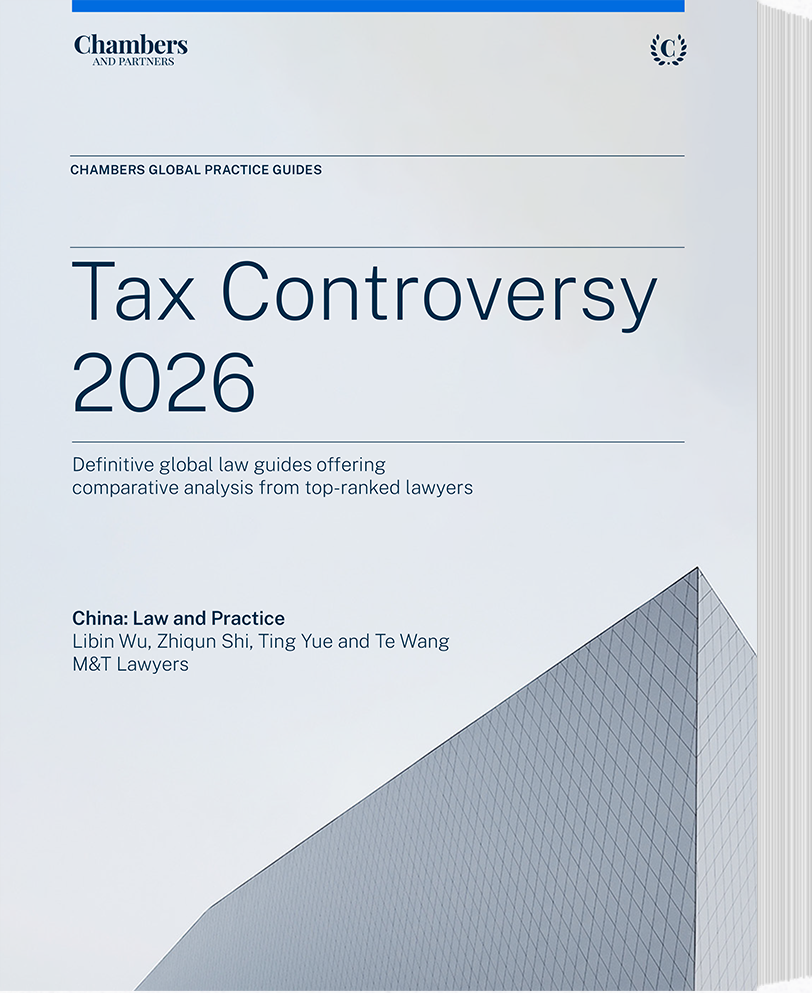
As a globally recognized authoritative legal reference, the Chambers Global Practice Guide compiles professional insights from leading law firms and senior practitioners across jurisdictions, focusing on cutting-edge legal issues in each region. It serves as a key resource for multinational enterprises, in-house counsel, and tax professionals seeking to understand cross-border legal frameworks and industry trends. For this edition, the M&T team drafted the full China tax law and practice chapter, presenting a comprehensive and practical overview of core tax rules and dispute hotspots in China.
The guide covers the entire lifecycle of domestic tax disputes across thirteen major sections, including causes of tax disputes, tax audits, administrative reconsideration, judicial litigation, alternative dispute resolution, administrative and criminal tax risks, cross-border tax disputes, international tax arbitration, and cost of enforcement.
Incorporating regulatory developments from 2025–2026, it highlights key topics such as the application of new rules under the effective VAT Law,audit priorities under Golden Tax IV and smart tax supervision, and administrative changes driven by CRS cross-border information exchange. It also reviews sector-specific tax risks in renewable energy, live-streaming e-commerce, cross-border e-commerce, private equity, and HNWI individual taxation, while offering professional responses to frequent challenges like transfer pricing, anti-avoidance, and criminal tax risk prevention—balancing expertise, foresight, and practical utility.
With years of deep focus on tax legal services, M&T is a premier specialized tax law firm in China, having been consistently ranked in Chambers Greater China and Asia-Pacific tax law recommendation lists for multiple consecutive years, earning sustained recognition from international rating agencies. Headquartered in Beijing, with branch offices in Shenzhen, Shanghai, and Fuzhou, the team comprises graduates from top domestic universities such as Peking University, with core lawyers holding dual or triple qualifications as attorneys, CPAs, and tax agents,enabling an integrated "law-tax synergy" service capability.
Leveraging solid professional foundations, M&T's practice spans the full spectrum of tax legal services, including tax dispute resolution, foreign income reporting and compliance, transfer pricing and anti-avoidance, cross-border taxation, M&A tax structuring, and private tax services for HNWIs.Its clients range from large state-owned enterprises, listed companies, and multinational corporations to tech startups and high-net-worth individuals.
The firm has handled a vast number of complex cases involving tax audits,administrative reconsideration, administrative litigation, and criminal tax matters, effectively managing tax risks and resolving taxpayer-authority disputes. Additionally, the firm provides tax policy advisory and decision-making support to government agencies, actively participates in industry tax rule research, and maintains deep insight into China's tax regulatory trends.
The online version of the Chambers 2026 Global Tax Disputes Guide is now available on the Chambers official platform. For the full M&T-authored chapter, please visit the M&T official website. If you would like a PDF copy of the chapter, feel free to leave a message via this public account.
Looking ahead, M&T will continue to leverage its professional strengths,provide in-depth analysis of domestic and international tax laws and regulatory policies, and deliver cutting-edge industry perspectives. With professional excellence, the firm remains committed to helping clients achieve compliance, effectively manage tax disputes, and contribute to the ongoing development of the tax legal services sector.




Top